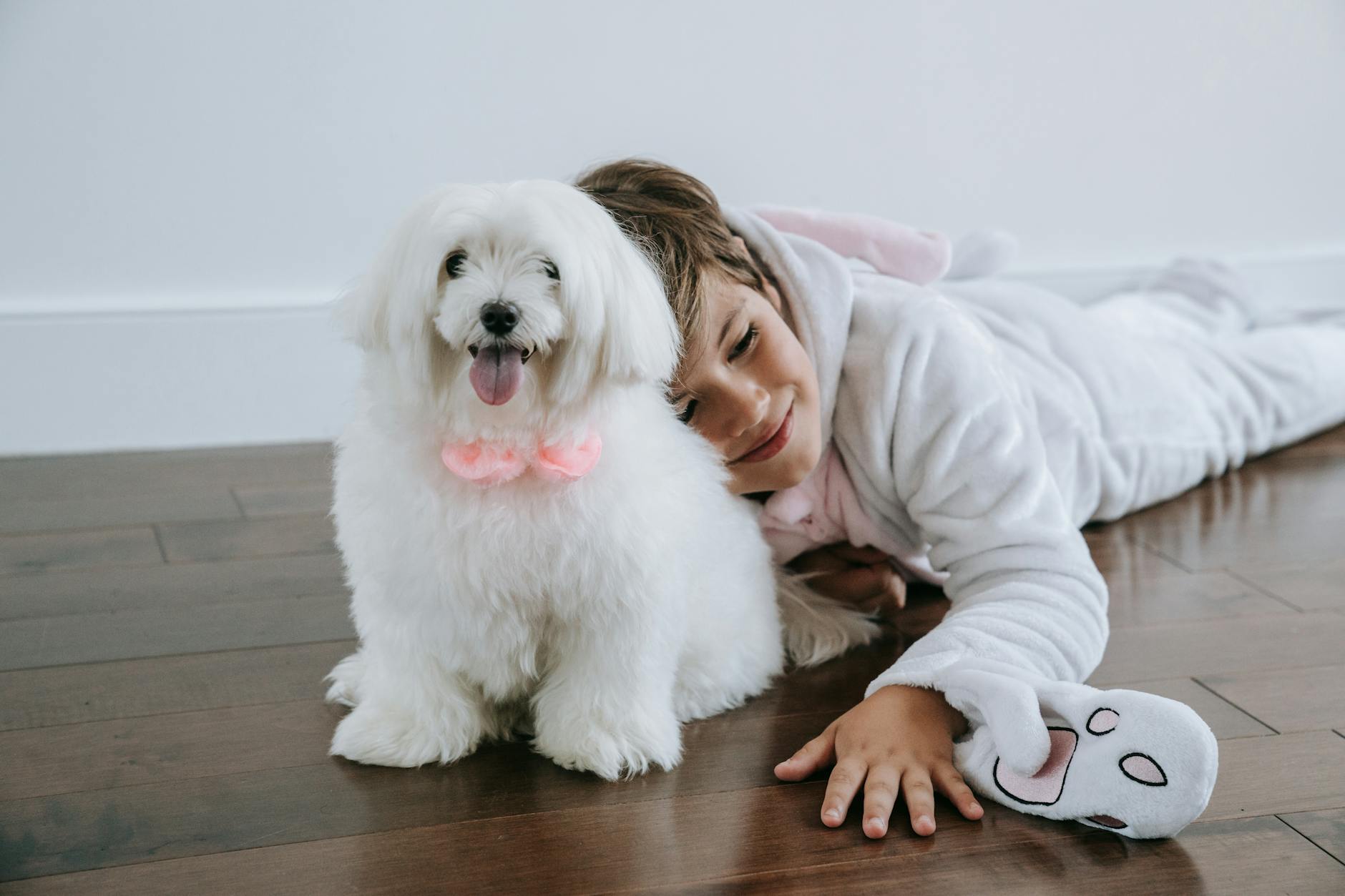
Kids love playing with dogs, but not all dogs know how to play safely with kids, and parents don’t have time to constantly referee the fun.
Even parents with time for constant supervision can find it impossible to know when to step in. After all, you want your dog to play with the kids. How can you know when things are getting unsafe?
This article deals with everything parents should know about safe play between dogs and kids. At the bottom you will find a list of FAQ’s from parents.
1. Set Boundaries for Rough Play
Rough play, especially with young kids, should be avoided.
Wrestling, chase, bitey hand, or games involving jumping or biting can easily get out of hand. Dogs do better with structured games.
Fetch, hide-and-seek, and scavenger hunts are great alternatives. Tug-of-war and chase can be good with some dogs and kids as long as there are rules. Always discourage aggressive or overly physical interactions from either party.

2. Recognize Dog Body Language
Help your child understand when a dog is happy and when they need a break. A wagging tail doesn’t always mean a dog is happy.
Look for signs of stress like lip licking, yawning, stiff posture, or growling. These are your cues to pause the play. Learn more here.
3. Play Safely with Toys, Not Hands
Encourage your dog and child to use toys during play. This makes play safer by directing your dog’s attention (and their teeth) toward the toys, not kids.
Using hands to tease or play with a dog can easily lead to accidental bites. This is especially true if the dog gets over-excited, confused, or frustrated while playing. If we want dogs to play safely with kids, we need to make it easy for them to do so!
Check out some of my favorite toys for kids and dogs!

4. Teach Respect on Both Sides
Start by teaching your child to respect the dog’s space. No pulling ears, poking eyes, or sitting on them like a pony. Likewise, your dog should learn basic commands like “sit,” “stay,” and “leave it” to help manage their behavior during play.
If your child stops playing, your dog should stop as well.
5. Supervise All Interactions
Never leave your child and dog unsupervised, especially for younger children, or children who struggle to follow directions.
Even the most gentle dog can react unexpectedly if they feel threatened, overwhelmed, or startled. Any dog, even the most well-behaved dog, can become pushy and unpredictable during play.
6. Create a “Safe Zone” for Your Dog
Make sure your dog has a space where they can go to rest or escape if they’re feeling overwhelmed. Teach your child that when the dog goes to this area, it means playtime is over for now.

7. Use Positive Reinforcement
Playing safely with kids is not easy for dogs, even though it is fun. Make sure to reinforce their good behavior!
Praise and reward both your child and dog for good behavior. Use treats, kind words, or extra playtime as positive reinforcement to build a strong foundation for safe interactions.
Dog and Kid Safety FAQ’s
How can I know when play is becoming unsafe?
This is difficult because every dog is different. Body slamming, mouthing, pushing, and even vocalizations can be indicators that things are becoming unsafe.
One thing I like to look at is how long the play has been going on. Play tends to spiral after a few minutes uninterrupted, so short sessions and frequent breaks can help keep things calm.
What rules should I set around dog/child play?
Every dog and every child is different. When you set rules for the kind of play that is acceptable in your home, it’s important to consider the age and temperament of both the dog, and the child.
Is mouthing normal or is my dog being aggressive?
Most mouthing (when the dog gently places their mouth on human skin without closing it) is a normal play behavior. It is especially common in retrievers and gun dogs.
But just because it is normal, doesn’t mean it is safe. It is still very easy for a dog to bite down just a bit too hard on a child.
I recommend teaching these dogs to play with a toy in their mouth to prevent accidents.
One adult family member likes to play rough. Is that going to ruin my dog when the kids are around?
Not necessarily, especially with an older dog. Your dog can adapt their play style to different family members (although it’s harder for them). Make it very clear to your dog when roughhousing is an option by only playing rough with one special toy.
Children, however, will copy what they see adults modeling. I recommend saving the rough play for after the kids are in bed.
Can my dog and child play chase or tug of war?
That depends on the dog and the child. Older kids and well trained dogs may do fine with these games. For young dogs who frequently re-grip tug toys or bite anything that moves, these games may be problematic.
While it’s fun to chase and wrestle, not all dogs enjoy that type of play. What’s more, many dogs will become overstimulated while roughhousing. This can lead to inappropriate jumping, pushing, and even biting.
Know your dog and your kid, and err on the side of caution when deciding what is safe in your home.
Final Thoughts
The relationship between your child and your dog can be the most rewarding aspect of growing up with a pet. With the right guidance and boundaries, their playtime will be filled with fun, laughter, and unforgettable memories.
Do you have a favorite game your child and dog love to play? Share it in the comments below!


Leave a Reply